

Hospitals today are busier than ever. Even small gaps can turn into serious medical errors -a missed ID check, a mislabeled sample, or a rushed handoff. Such a high patient load often increases the risk of medical errors. Moreover, medical errors are not always dramatic. Often, they happen in seconds. And the impact can last a lifetime.
However, NABH standards provide structure, checks, and accountability that ensure care remains consistent and safe. From clear protocols to continuous monitoring, these guidelines minimise gaps across departments.
Kasturi Medical Centre, a noteworthy NABH-accredited hospital in South Kolkata, adheres to these standards to ensure precision in treatment and safer outcomes, even in high-volume settings.
Today’s blog will discuss how NABH standards create systems that reduce medical errors in high-volume hospitals.
Why medical errors spike in high-volume hospitals
Medical errors spike in high-volume hospitals due to workload pressure, time constraints, communication gaps, and process fatigue, all of which increase the chances of oversight, delayed decisions, and coordination failures across departments.
Without a strict structure, chaos quietly grows.
The “throughput tax”: handoffs, fatigue, crowding, interruptions
The “throughput tax” refers to errors driven by frequent handoffs, staff fatigue, overcrowding, and constant interruptions. This disrupts focus, fragments communication, and increases the risk of missed or incorrect clinical decisions.
The big 5 error buckets (ID, meds, surgery, infections, communication)
Most hospital errors fall into five predictable areas:
| Error Type | What Goes Wrong | Impact |
| Patient ID | Wrong patient mix-ups | Wrong test / wrong treatment |
| Medication | Incorrect dose or drug | Severe reactions |
| Surgery | Wrong site / wrong procedure | Catastrophic harm |
| Infection | Poor hygiene or device care | Extended stay |
| Communication | Incomplete handoff | Delayed treatment |
The good news? These are preventable. If systems are strong.
What NABH actually means
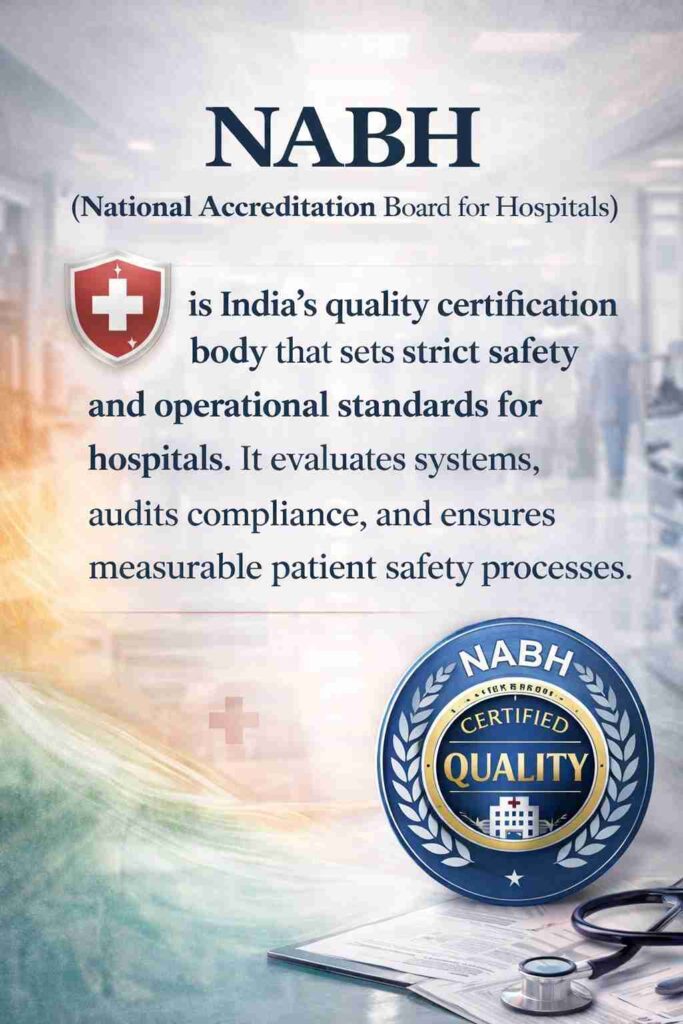
NABH (National Accreditation Board for Hospitals) is a set of structured, evidence-based standards that ensure hospitals follow strict protocols for patient safety, clinical processes, hygiene, and accountability, thereby reducing care variability and improving overall treatment quality.
These NABH accreditation benefits for patients translate into safer care, consistent treatment practices, and reduced chances of medical errors across hospital departments.
NABH’s focus: standardised processes + audits + continuous improvement
NABH standards for hospitals demand:
- Written SOPs
- Measurable indicators
- Internal audits
- Ongoing staff training
Patient-centric vs organisation-centric standards (why that matters operationally)
Patient-centric standards protect you directly. Organisation-centric standards strengthen backend systems.
Together, they reduce errors across departments. That is exactly how NABH reduces medical errors becomes reality, not marketing.
The simplest way to understand NABH: it builds error-proof systems
NABH creates structured workflows, documentation discipline, and accountability layers that prevent mistakes before they reach patients. It turns unpredictable human environments into controlled clinical systems.
Standard Operating Procedures (SOPs) that survive chaos
In emergencies, memory fails. SOPs do not.
Clear, written instructions ensure:
- No step is skipped
- Roles are defined
- Escalation pathways are clear
Documentation + traceability
Documentation under a clinical audit NABH hospital framework ensures traceability. If something goes wrong, root causes are identified quickly.
Exactly how NABH reduces medical errors
NABH reduces medical errors through patient identification checks, medication safety controls, surgical verification protocols, infection audits, and structured communication systems embedded into daily hospital workflows.
Correct patient identification (stops “wrong patient” cascades)
Patient mix-ups trigger serious errors, so NABH mandates strict identification protocols at every care point to prevent wrong-patient incidents and ensure treatment accuracy.
Two-identifier checks at registration, sample collection, and drug administration
Every patient is verified using two identifiers, typically name + date of birth or name + UHID, before any procedure, sample collection, or medication administration.
Barcode/wristband workflows
Wristbands and barcode systems minimise confusion, and even if digital systems fail, mandatory manual double-verification. This ensures no shortcuts and reinforces the core patient safety protocols NABH enforces.
Medication safety controls (where most preventable harm hides)
Medication errors are among the most common yet preventable risks, so NABH enforces strict checks across prescribing, dispensing, and administration to reduce errors and protect patient safety.
High-alert meds: segregation, double-checks, tall-man lettering
Under the medication safety NABH guidelines, high-risk drugs are:
- Stored separately
- Double-checked
- Clearly labeled
Look-alike/sound-alike (LASA) drug handling
LASA drugs are segregated and highlighted.
| Risk | NABH Control |
| Similar drug names | Tall-man lettering |
| Similar packaging | Physical separation |
| Dose confusion | Double verification |
Medication reconciliation
At admission, transfer, and discharge, medication lists are verified. This prevents duplication and harmful interactions.
Safe surgery & procedure verification
Surgical errors are rare in structured systems.
Consent + site marking + timeout checklist
Before incision, a surgical “timeout” confirms:
- Right patient
- Right procedure
- Right site
OT count protocols + specimen labelling
Instruments are counted. Specimens are labelled immediately. Precision saves lives.
Infection prevention & control (IPC) that’s measurable
Infections prolong suffering. But they are measurable and controllable.
Hand hygiene compliance audits
Under the NABH infection control standards, hand hygiene is tracked as a percentage.
Device-associated infection bundles (CLABSI/VAP/CAUTI style approach)
CLABSI, VAP, and CAUTI bundles reduce ICU infections.
Sterilisation cycle monitoring + biomedical waste discipline
Sterilisation cycle monitoring with strict biomedical waste management protocols.
| IPC Indicator | Why It Matters |
| Hand hygiene % | Prevents cross-infection |
| HAI rate | Measures hospital safety |
| Sterilisation logs | Ensures instrument safety |
Communication & handoff standardisation
In high-volume hospitals, unclear communication is one of the most dangerous risks. Structured handoff protocols ensure critical patient information is transferred accurately, reducing preventable errors and protecting patient safety.
SBAR-style handoffs
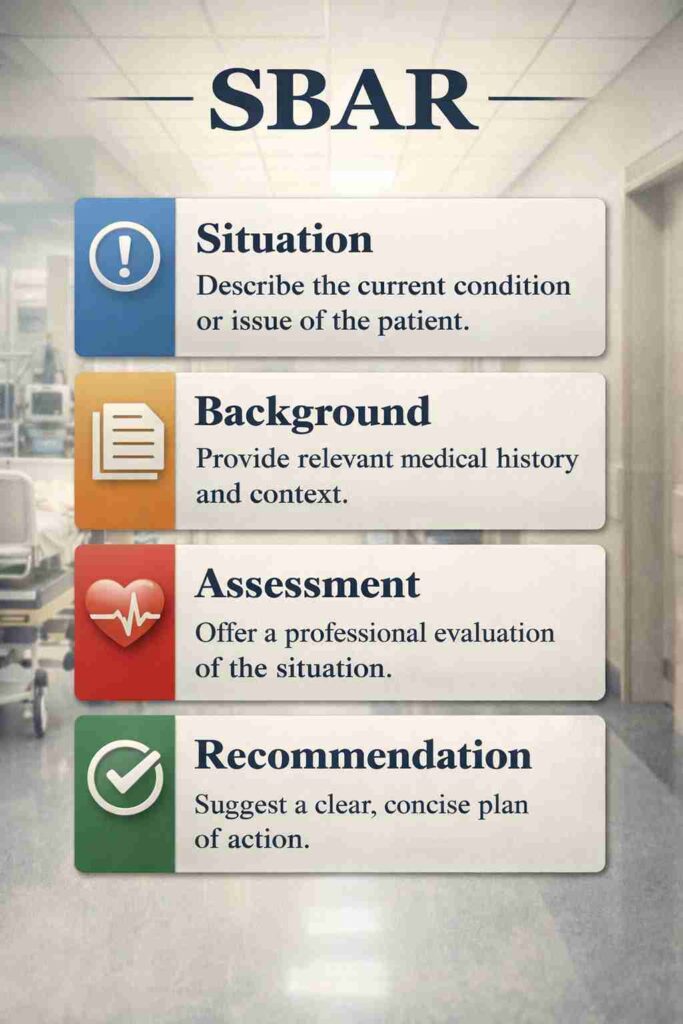
SBAR-style handoffs provide a structured way to clearly and quickly communicate critical patient information.
- Situation: What is happening right now?
- Background: What relevant clinical history or context matters?
- Assessment: What is your clinical evaluation of the problem?
- Recommendation: What action is needed next?
Critical value reporting + readback protocols
Lab alerts are read back to confirm accuracy. An effective incident reporting system in hospitals (NABH) ensures near-misses are documented before harm occurs.
The NABH mechanisms competitors don’t explain
NABH requires internal audits, incident reporting, root cause analysis, corrective actions, staff training, and reinforcement of safety culture. These mechanisms proactively prevent recurring errors.
- Internal audits: Nonconformities are identified early.
- Incident reporting → RCA → CAPA: Every incident triggers Root Cause Analysis and corrective action.
- Training cadence: Nurses, OT staff, and pharmacy teams undergo competency checks.
- Safety culture: Reporting without fear is encouraged. That’s how real safety grows.
KPIs to track in a high-volume NABH hospital
Teams are serious about safety tracking numbers relentlessly.
| Domain | Medication Safety | Infection Control | Patient Identification & Diagnostics | Surgical & Clinical Outcomes |
| KPIs | Medication Error RateNear-Miss RateLASA Incidents | Hand Hygiene Compliance % SSI Rate HAI Rate Needle-Stick Injuries | Patient ID MismatchesSample Rejection RateTransfusion Reactions | OT Checklist ComplianceReadmission RatePatient FallsPressure Injuries |
| What It Indicates | Errors in prescribing or drug administration systems | Effectiveness of infection prevention measures | Accuracy of patient verification and laboratory workflows | Adherence to surgical safety and clinical care standards |
| Why It Matters | Prevents medication-related harm and adverse drug events | Reduces hospital-acquired infections and staff injuries | Prevents wrong-patient treatment and diagnostic errors | Prevents surgical mistakes and improves patient recovery outcomes |
Kasturi Medical Centre, a reputed NABH hospital in South Kolkata, adheres to all safety metrics and signals accountability.
What changes first in busy city hospitals
In busy hospitals, NABH implementation first improves triage systems, diagnostic labelling accuracy, transfer documentation, and patient communication clarity.
OPD/ER crowding
Structured triage protocols prioritise critically ill patients quickly, reducing delays and preventing risk during peak patient load.
Diagnostics bottlenecks
Strict labelling and verification discipline minimise sample rejection and maintain diagnostic accuracy even during high testing volumes.
Referral/transfer load
Standardised documentation and handoff protocols ensure continuity of care and prevent treatment delays during patient transfers.
What patients in Kolkata can ask
- How is patient ID verified?
- Are high-alert drugs double-checked?
- What is the hospital’s HAI rate?
- Is it NABH accredited?
If you are looking for the best NABH-accredited hospital in Kolkata, ask these questions confidently.
At Kasturi Medical Centre, these are not uncomfortable questions. They are welcome.
NABH vs JCI (quick comparison)
Both NABH and JCI focus on patient safety and measurable quality systems. NABH is widely adopted in India, while JCI is international. Audit styles and operational focus differ slightly.
Similarities: Patient Safety Goals and Measurement Culture
Both focus on patient safety, measurable outcomes, structured audits, and continuous quality improvement.
Differences: Adoption, Audit Style, Typical Use-Cases
| Parameter | NABH | JCI |
| Adoption | Widely used in India | Limited, mostly premium hospitals |
| Audit Style | Indian regulatory alignment | International benchmarking |
| Typical Use Case | Quality and compliance within India | Global reputation and medical tourism |
When comparing NABH vs JCI accreditation in Kolkata, the practical choice for Indian patients often remains NABH due to alignment with the local context.
People Also Ask
Does NABH accreditation guarantee “no medical errors”?
No system can eliminate all errors. However, NABH significantly reduces preventable errors by enforcing structured safety protocols and audits.
Which NABH standards impact medication errors the most?
Medication reconciliation, high-alert drug protocols, LASA handling, double-verification systems, and documentation audits have the greatest impact.
How long does it take a hospital to become NABH compliant?
Typically, 12–24 months of structured preparation, documentation, training, and internal audits before final accreditation.
What’s the difference between NABH-accredited and NABH entry-level/pre-accreditation?
Entry-level is a foundational compliance stage. Full accreditation indicates complete implementation of NABH standards, with audited performance metrics.
For accountable, system-driven care, consult Kasturi Medical Centre, a trusted NABH hospital in South Kolkata committed to patient safety at every step.
Enquire More Today.